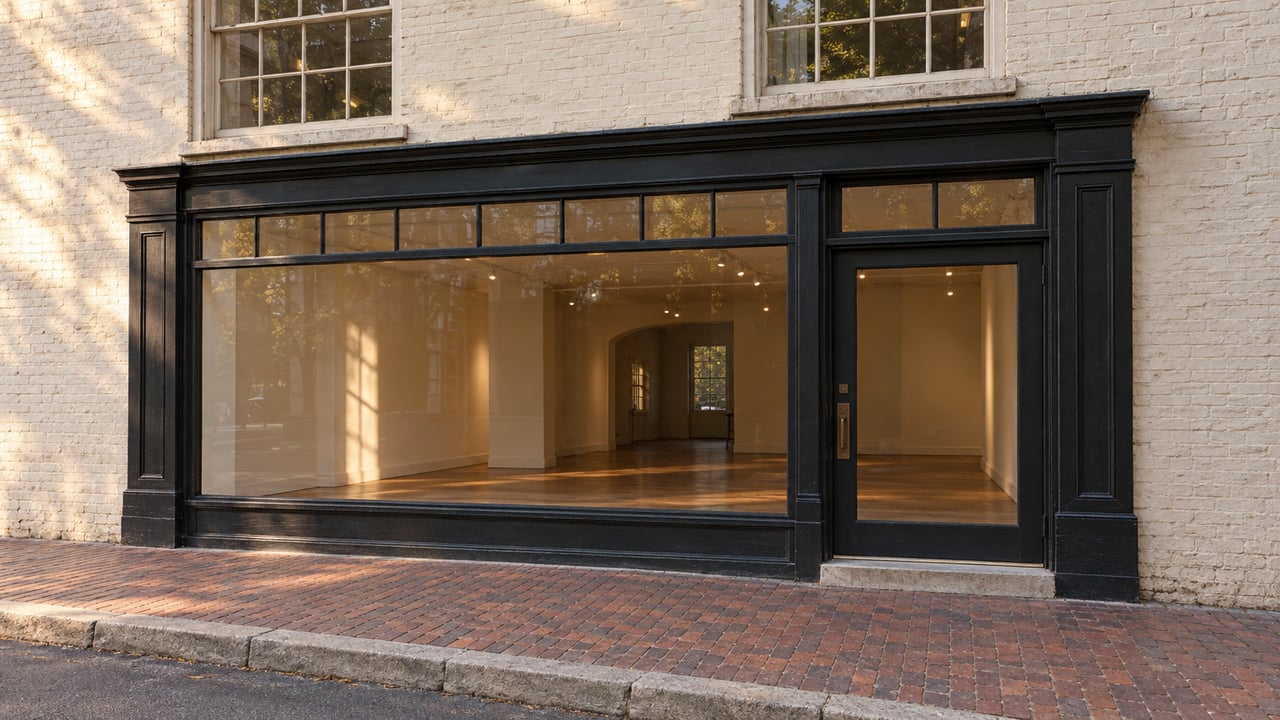
"New & Coming Soon to King Street!" the street's own Instagram account posted earlier this month, previewing a run of storefronts that reads more like a commercial leasing report than a lifestyle update. Dôen is taking a space at 337 King. Palmetto Moon, the fan-apparel and Southern-lifestyle chain that started as a kiosk in the Citadel Mall in 2002, is opening its hometown store at 360 King ahead of its 25th anniversary next year. Granado, a fragrance and body-care house founded in Rio de Janeiro in 1870, is expanding into the same stretch. These are national brands with real estate budgets, and they are choosing King Street on purpose.
A few blocks away, at 395 King Street, five much smaller storefronts opened this spring inside a building the city has owned since 1992. None of the businesses there are household names yet. That gap, national retailers signing leases on one end of the street while the city hands out subsidized suites on the other, is the actual story of King Street this fall. It is not a competition. It is two different answers to the same problem: storefront space on King Street costs more than most new businesses can absorb on their own.
The Blocks Where Ownership Changed Hands
Below Market Street, the King Street real estate itself has been moving. Onward Reserve, an Atlanta-based menswear brand, paid $8 million for the three-story building at King and Market, a corner that had been under the same ownership for 37 years. The building's previous tenant, Christian Michi, held a moving sale and relocated to 149½ East Bay Street. The renovation includes restoring the building's 1800s millwork and historic windows.
That corner is not an outlier. Gwynn's of Mount Pleasant paid $3.1 million for 154 King St. for a second Charleston-area location. The pattern below Market is purchase, not lease. These are companies betting on King Street as a long-term address, not a seasonal storefront, and the price tags reflect it.
Upper King is where the retail incubator sits, and it exists because the city didn't have to compete for that real estate. As Live 5 News reported, the building at 395 King has belonged to Charleston since 1992. Rather than bidding against national brands for space, the city renovated what it already owned and turned it into Palmetto Row Collectives, five boutique retail suites launched this spring as part of the city's Retail on King initiative. Nearly 50 entrepreneurs applied for those five spots.
The tenants who got in include Daniela Salgado, who spent four years selling painted pottery at the Charleston City Market before landing her own storefront as Daniela De Art3. Juliette Mills Lutterodt opened The House of Juls there. As Count on 2 reported, Ruth Jordan, who manages the city's Small Business Enterprise and Entrepreneur Resource Center, said:
"Palmetto Row Collectives serves as a vital catalyst, ensuring that local small businesses can thrive on King Street through accessible, affordable retail space and direct business development tools."
That's the actual mechanism. The incubator isn't correcting the price pressure on King Street. It's routing around it, using land the city already controlled instead of trying to outbid an $8 million buyer for a storefront it doesn't own.
The Food Side Is Moving Just as Fast
The restaurant and café openings this year outpace the retail news, and they're distributed differently. PopUp Bagels is taking 83 Mary Street. Bareo, a Filipino-Japanese concept built around dumplings and kakigori, is opening from local restaurateurs. The Cooper, a development at 176 Concord Street, is bringing three concepts online at once: The Crossing for coastal Mediterranean seafood, CurrentBurger for smash burgers and shakes, and Cooper Coffee & Wine, a marina-view spot that functions as a café by day and a wine bar at night.
Cachita's Kitchen made the jump from food truck to brick-and-mortar on North Market Street with Mexican street-style tacos and burritos. Babas on King opened in January serving pastries and espresso in the morning and cocktails by evening, styled after neighborhood cafés in Italy, France, and Spain. At the Mills House hotel, Iron Rose Bar & Restaurant brought on Suzy Castelloe as executive chef in February, a Carolina native who trained at Charleston Grill and Coda del Pesce before taking over the kitchen at 115 Meeting Street.
This density of openings isn't happening in a vacuum. Yelp and Lyft named Charleston the No. 2 foodie city in the country for 2026 in a report released September 1, ranking it behind only New Orleans and ahead of San Diego, Miami, San Francisco, and New York. The ranking wasn't based on critic reviews. It combined Yelp search volume, saves, and photo uploads with Lyft data on where people actually asked to be driven. Blind Tiger on Broad Street and Henry's on the Market pulled the most riders. Breakfast and brunch was Charleston's most-searched category, matching a national pattern where nearly one in five restaurant-bound Lyft rides happen before noon. Italian cuisine ranked third most-searched in Charleston specifically, which tracks with how many of this year's new openings lean Italian or Mediterranean.
The One Sunday a Month When None of This Matters
All of that new inventory, the $8 million corner, the five-suite incubator, the dozen new kitchens, gets tested the same way once a month. On the second Sunday, King Street closes to vehicle traffic from Queen Street to Calhoun, a stretch of roughly half a mile, starting at noon and reopening at five. Merchants set up in front of their own storefronts, food vendors work the sidewalks, and restaurants move tables outside. The event has run long enough to survive its own weather cancellations, including one October when major coastal flooding forced organizers to call it off and push the tradition to November instead.
The next two fall dates are October 11 and November 8. On those afternoons, a shopper walking from Onward Reserve's corner up to Palmetto Row Collectives covers the same half-mile whether they're heading toward an $8 million storefront or a five-suite incubator that cost the city nothing to acquire. The street doesn't distinguish between the two on a closure day, which is arguably the clearest evidence that both bets are paying off at once.
What Else Is Filling the Fall Calendar
King Street's retail and food news is landing in the middle of a busy stretch on the city's own calendar. The MOJA Arts Festival opened September 24 in Marion Square and runs through October 1 across venues downtown, with programming that includes a Food Truck Gullah Geechee Cook-off, a Reggae Block Dance, and gospel performances. The Preservation Society of Charleston's Fall Tours run October 1 through 31, offering walking tours and house and garden tours through the city's historic districts. And on October 10, St. Matthew's Lutheran Church hosts Oktoberfest Charleston right on King Street itself, at 405 King, with free admission, live music, German food, and a biergarten running from 11 a.m. to 6 p.m.
None of these events depend on which storefronts are open or who owns them. They're the fixed points on a calendar that the new leases and the new incubator suites are simply filling in around. What's changed this fall isn't the rhythm of King Street. It's how many more reasons there are to be on it when that rhythm hits.
If you're curious about how the commercial shifts on a street like King affect the residential blocks around it, or want a local read on what a corridor's changing storefronts actually signal for the neighborhood nearby, PRL Consulting Group keeps a close eye on downtown Charleston's pulse and is glad to talk through what it means for where you live.